Hospital · Radiology · Imaging · Laboratory
One platform for every clinical department.
MediTrac runs hospital management, radiology reporting, imaging and the laboratory as a single system. There is no integration project, because there is nothing to integrate.
- 2
- Hospitals live in NigeriaRunning today
- 4
- Modules, one systemHMS, RIS, PACS and LIS
- ₦0
- Per-study feesFlat annual licence
- On-premise
- Or cloud, your choiceData can stay on site
Both run MediTrac on their own servers, so the building keeps working when the internet does not. A CT scanner pushes studies straight in, radiologists report from off site, and every study is backed up encrypted off the premises.
The problem
The money does not go missing. It is never recorded.
Every handover between departments is a place where a charge can quietly fail to exist. Nobody steals anything. The patient is treated, and the record of it never reaches the invoice.
We will not quote you an industry percentage. Ask your own finance officer what last week looked like. That answer is the business case, and it is yours, not ours.
Where it goes
- A test is ordered verbally, run, and never billed.
- A patient collects drugs and leaves before the charge is raised.
- A scan is reported and the reporting fee never reaches the invoice.
- A nurse performs a procedure no invoice hears about.
- A patient is told to return in two weeks. Nobody follows up.
- A result is filed on paper, so it is ordered a second time.
Clinical modules
Four modules. One system. Nothing to integrate.
Each works on its own. Together they close the gaps between departments where information and revenue are lost.
Hospital Management
The clinical and operational core
- One searchable record per patient
- Patients routed between departments automatically
- Notes, diagnoses and prescriptions
- Charges captured at the point of care
Radiology Information
Order to signed report
- Patient details sent straight to the scanner
- Structured reporting from your own templates
- Peer review with a formal record
- Radiation dose register for the regulator
Picture Archiving
Enterprise DICOM imaging
- Full viewer in the browser, nothing to install
- CT, MRI, X-ray, ultrasound, mammography, ECG
- Images and the signed report in the patient’s record
- Images stored on site if you require it
Laboratory Information
Order to authorised result
- Barcoded specimens from collection onward
- Analysers post results in directly
- Abnormal and critical values flagged as they arrive
- A scientist authorises before anyone sees a result
Radiology and imaging
Your hospital system is also your reporting system and your image archive.
The images, the report, the order and the invoice are already the same system. There is no interface to build, licence or maintain.
A standalone viewer
The image, and nothing else.
- No clinical question to answer against
- No record of whether it was paid for
- Priors elsewhere, if they were kept
- The report typed in another system
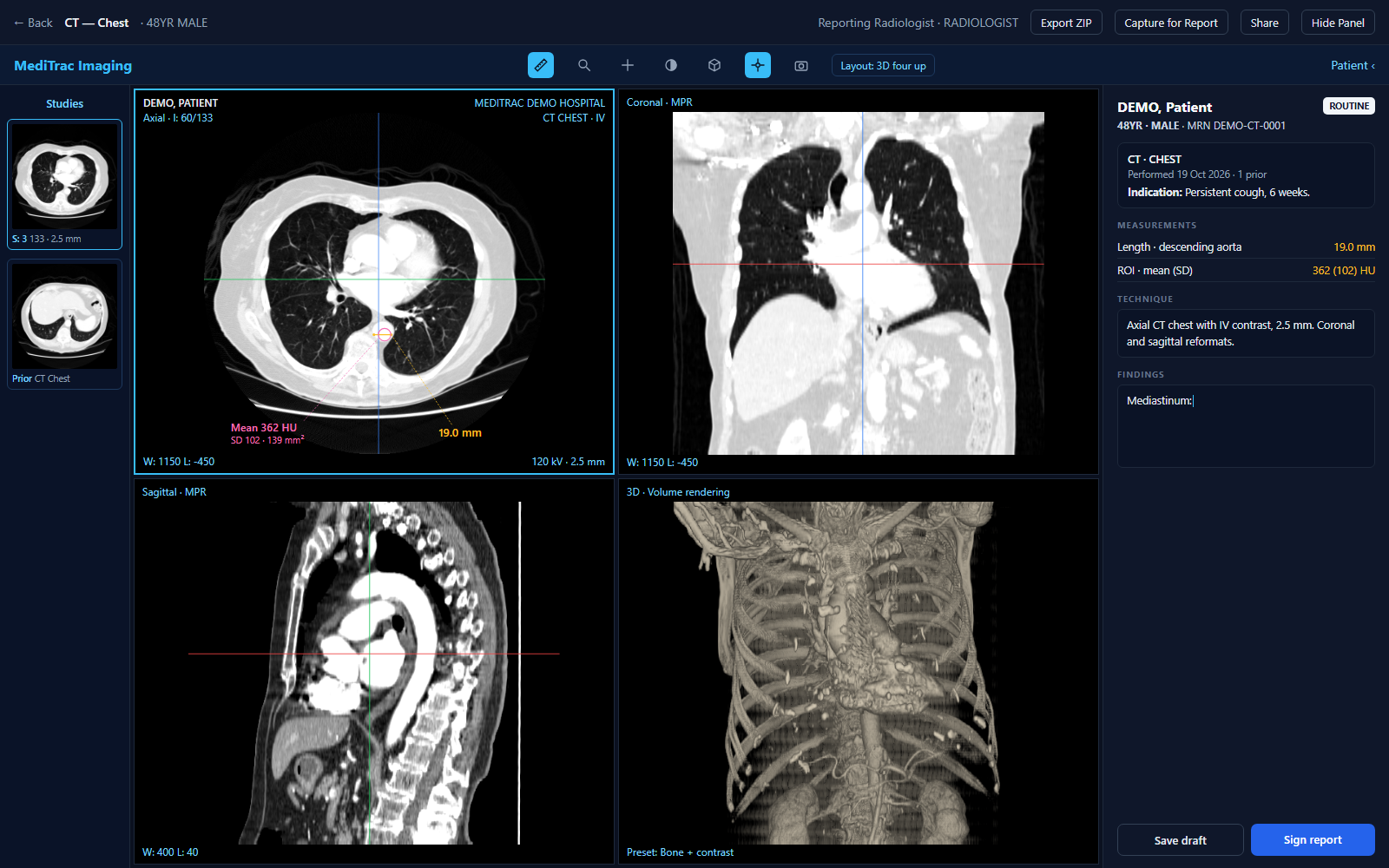
MediTrac, same screen
The image, in context.
- Indication. Why the scan was requested.
- Billing. Confirmed before the scan.
- Priors. Already open beside it.
- Report. Template loaded, ready to sign.
The scanner fills itself in
Patient details go to the modality from the order, so nobody retypes a name at the console.
Context beside the image
The clinical question, the billing status and the patient’s priors, already on screen.
Priors without searching
Previous studies load alongside the current one, so comparison takes seconds.
Templates, not a blank page
Your own report templates, matched to the study and ready to edit.
Peer review on the record
Reports can be reviewed and discrepancies logged, which is what an assessor asks to see.
A dose register to hand over
Dose captured per study and exported for the regulator, recorded as you scan.
AI report drafting · optional
You make the diagnosis. MediTrac drafts the report.
- Your words. The radiologist notes what they see; the draft arranges it into findings and an impression.
- Nothing added. The AI never sees the images, and it is told never to add a finding the radiologist did not state. The radiologist checks every line.
- Signed by a person. Every draft is edited and signed by the radiologist before anyone sees it.
- Your choice. Off unless your hospital switches it on.
No per-study fees. Every scan. For as long as you licence it.
No charge per transmission and no separate storage bill. A busy department does not become more expensive to run because it is busy.
Laboratory
A result reaches the clinician only after it has earned the right to.
Any system can store a number and print it. The work is deciding which numbers a human must see first, and refusing to release the ones that have not passed.
- 01
Order
Raised by the doctor or front desk, priced from your catalogue.
- 02
Collect
The right tubes worked out for you, each one barcoded.
- 03
Run
Analysers post results back, matched to the sample.
- 04
Check
The system decides what a human must see before release.
- 05
Authorise
A scientist releases it. Only then is it visible.
Quality control that blocks
When an analyte is out of control, its results do not leave the laboratory until the failure is resolved or formally accepted. That decision carries a name and a reason.
Ranges that know the patient
Normal is not one number. Ranges vary by sex and age, and critical values are set by your laboratory rather than guessed by the software.
Checked against their own history
A result is compared with that patient’s previous value. An implausible jump goes to a scientist instead of to the ward.
Ready for assessment
The quality records an ISO 15189 assessor expects are kept as you work, not assembled the week before an inspection.
Worth asking any vendor. If quality control fails this morning, can a technician still sign out this afternoon’s results for that test? With MediTrac the answer is no.
Add when you are ready
Start with what you need. Switch on the rest later.
Each is already part of MediTrac, so adding one later is a switch, not a new installation or a new system to learn.
Remote reading portal
Radiologists outside the hospital open studies over an encrypted connection, with a record of who opened what.
Off-site backup and recovery
Every study is backed up, encrypted, off the premises, and the records are mirrored to the cloud. If the server is lost, the images are not.
AI report drafting
The radiologist’s own observations, arranged into findings and an impression, ready to edit and sign.
Deployment
Built for how hospitals here actually operate.
Power and connectivity are not assumptions we make. Choose where it lives, and it behaves the same either way.
Cloud hosted
We run it. You log in.
- Live in about a week, no hardware to buy
- Updates and patches handled for you
- Reachable from anywhere you authorise
- Suits hospitals without an IT team
On premise
Your servers. Your network. Your data.
- Records never leave the hospital
- Keeps working when the internet does not
- The same features as the cloud
- Suits government and teaching hospitals
When the internet drops
On premise, the system runs on your own network and keeps going.
When the power goes
It comes back up on its own. Nothing is held only in memory.
When you want to leave
It is your data. Export it in standard formats and go.
Governance
The questions your board will ask, answered first.
Buying a clinical system is a governance decision as much as a clinical one.
Data protection, in writing
A policy, a breach response plan and a processing agreement your legal team can read before you sign.
Radiation dose reporting
Captured per study and exported for the regulator, recorded as you scan.
Laboratory quality records
The documentation an ISO 15189 assessor expects, kept as part of the work.
Data residency you choose
On premise, records and images stay inside the hospital. That is your decision, not ours.
Every action attributable
Who saw what, and who changed what, is answerable after the fact.
Access by role
Each role sees what the work requires. Clinical data is not an administrative convenience.
Straight answers
The things hospitals actually ask.
Including the ones a sales page usually avoids.
What happens when the internet goes down?
On premise, nothing. The system runs on your own network. A cloud deployment needs connectivity, which is why we offer both and will tell you which one suits your hospital.
Who owns the data?
You do. It can be exported in standard formats, and images in DICOM, which every other archive reads. We do not hold records hostage as a commercial strategy.
We are entirely on paper. How does this start?
With registration and billing, where the value shows fastest. Old files are not keyed in wholesale. Patients join as they attend, so your active population builds itself.
How long until we are live?
About a week on cloud. On premise depends on your hardware. The real constraint is rarely software. It is deciding who does what, and training them.
Will it work with our scanner and analysers?
It speaks the standards they already speak. We confirm your specific models with you before anything is promised.
How is it priced?
A flat annual licence for the modules you choose. No charge per study, no separate storage bill, no penalty for a busy month. We quote against your hospital.
What about staff who resist it?
Resistance usually means the system is asking for more typing than the paper did. Where that happens we would rather change the workflow than insist on it.
What if we want to stop using MediTrac?
You export your data and you go. We would rather keep hospitals because it earns its place than because leaving is painful.
Next step
See it running against your own hospital’s workflow.
We will walk through hospital management, imaging, reporting and the laboratory live, and tell you plainly which parts suit you and which do not. If MediTrac is the wrong fit we would rather say so in the first half hour than the first year.
- Thirty minutes, live
- Your questions, not a script
- No cost and no obligation
- A straight answer on fit
Or write to meditracng@devalter.io